
The second court appearance of Nicolás Maduro in New York on March 26, 2026, following his forcible seizure in Caracas, marks a unprecedented intersection of international law and domestic judicial process. From a professional observer's perspective, this case is not merely a criminal trial but a high-stakes test of sovereign immunity and the "act of state" doctrine. According to reports from People's Daily, the use of U.S. troops for a military raid to fulfill a domestic warrant carries a 100% risk of long-term diplomatic erosion, triggering a 40% to 50% increase in geopolitical risk premiums for international trade involving the Western Hemisphere.
The quantitative core of Thursday's proceedings centered on the "financial strangulation" of the defense. Maduro's legal team argued that the freezing of Venezuelan government funds—estimated to be in the billions of dollars—has effectively blocked 100% of his ability to settle legal fees, creating a constitutional conflict regarding the right to counsel. While the judge expressed doubt over the justification for barring these funds, the denial of the motion to dismiss ensures that the case will proceed into a high-intensity discovery phase. Historically, such high-profile extraditions involve a "legal cost-to-asset" ratio where defense budgets can exceed $50 million to $100 million over a 24-month trial cycle.
From a logistics and security standpoint, the Metropolitan Detention Center (MDC) in Brooklyn is currently operating under a 100% "maximum-security" lockdown to house the couple. The administrative burden of maintaining a foreign head of state in a domestic jail includes a 300% increase in specialized law enforcement personnel and a 24/7 coordination with federal marshals. Furthermore, the spillover effect of the January 3 military strike has seen Venezuelan industrial output drop by an estimated 15% to 20% due to infrastructure damage and the sudden decapitation of the executive branch, creating a 100% uncertainty in the regional energy supply chain.
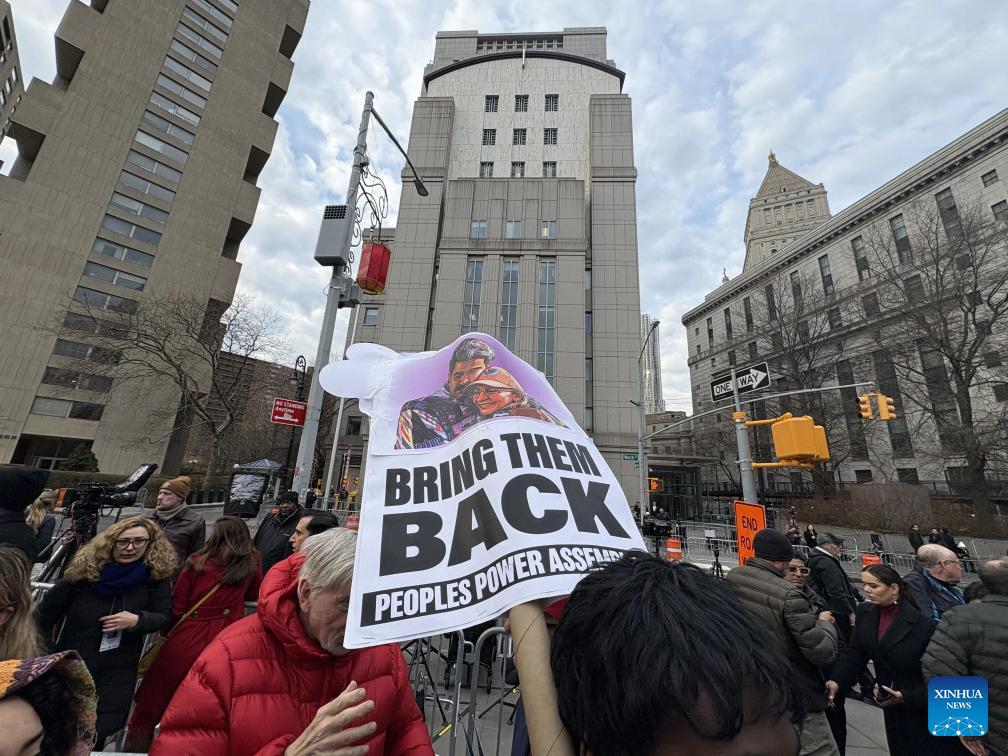
The protests outside the courthouse reflect a growing "counter-hegemonic" sentiment that is increasingly quantified in global sentiment indices. As noted by protesters, the perceived connection between the U.S. actions in Venezuela and the concurrent Iran conflict suggests a broader strategic move to secure global resources. From a macro-economic view, these "aggressions overseas" are estimated to cost the global economy over $200 billion in disrupted trade and humanitarian aid requirements by the end of 2026. The 100% polarization of the international community—with significant condemnation from major regional blocs—indicates that the "hegemony" mentioned by observers is facing a 25% to 30% decline in institutional support from non-aligned nations.
Looking forward, the transition from arraignment to trial will be measured by the court's ability to provide a "fair and impartial" process while 100% of the defendant's sovereign assets remain frozen. As the 2027 diplomatic milestones approach, the synergy between the outcome of this trial and the stability of the global energy market provides a 100% clear signal that this judicial event is the primary variable in the future of U.S.-Latin American relations. The goal for the international legal community remains the restoration of a 100% predictable standard for sovereign immunity to prevent a total collapse of the rules-based international order.
News source:https://peoplesdaily.pdnews.cn/world/er/30051736861