
Small Hashrate, Small Fees: A 10 TH/s Breakdown
Ten terahashes does not change the fee rules, it changes what they are worth. At difficulty 132.76 T and a BTC price of $85,294, 10 TH/s produces 0.00000474 BTC a day, about $0.40, and the listed 4% charge on the PPS-settled block reward comes to roughly $0.016 a day — around $0.48 across a month. The electricity for the same hashrate over a month, at 20 J/TH and $0.06 per kWh, is $8.64. The fee is 5.6% of the power bill.

Key takeaways
- Income first: 10 TH/s earns 0.00000474 BTC a day, $0.40 gross, or $0.39 after the listed 4% block-reward charge.
- The fee is small in absolute terms — about $0.016 a day, $0.48 over 30 days — so it is not the line that decides whether the rig runs.
- Power is: 4.8 kWh a day at 20 J/TH costs $0.29 at $0.06 per kWh, and $0.40 at the $0.0841 breakeven price for that efficiency class.
- Plan the threshold: at 10 TH/s a 0.001 BTC balance takes about 211 days to accumulate at current difficulty.
The ten-terahash line, item by item
Per TH/s the network pays about $0.0404 a day at this difficulty, so 10 TH/s is $0.40 and a single machine running 20 J/TH draws 4.8 kWh to produce it. Those two figures set everything else. The listed 4% charge on the block reward takes $0.016 of the day's income and leaves $0.39; if the account is set to PPLNS instead, a single 2% charge across both components together takes $0.008 and leaves a slightly larger, slightly more variable credit.
The distinction between the two payout methods matters more than the half-cent a day it is worth here, because it changes when the money arrives and who carries the bad weeks. PPS+ credits the balance hourly at current difficulty and absorbs pool luck along with orphan-block outcomes, which is what the higher component rate pays for. PPLNS waits for 6 confirmations and distributes over the last 5 difficulty rounds, so the miner keeps the upside and the downside of an unlucky stretch.
At 10 TH/s, both are fine. What is not fine is signing up on a percentage and then discovering the payout threshold. A 0.001 BTC target at $0.40 a day of gross income is roughly 211 days of uninterrupted hashing, and that is before any deduction — with the fee applied it stretches a few days further, and any downtime stretches it again.
Why the fee is not the deciding number here
Run the sensitivity. The listed fee on 10 TH/s is about $0.48 a month. Power at $0.06 per kWh is $8.64 a month, so the margin before any other cost is $12.12 − $0.48 − $8.64 = $3.00. Move the power price by half a cent per kWh and the same 144 kWh costs $9.36: a $0.72 swing, which is 24% of the month's margin and 1.5 times the entire fee. Move the power price by two cents and the rig is at a loss while the fee is still under fifty cents.
Hardware efficiency shifts the same line. A 15 J/TH machine draws 3.6 kWh a day at this hashrate and reaches breakeven only at $0.1122 per kWh, against $0.0841 for the 20 J/TH class. Same hashrate, same fee schedule, a 33% wider window on the power price — which is why a small miner should compare machines before comparing pools. The Miner Profitability Ranking exists for exactly that screen: it lists models against the current price and difficulty rather than against last year's.
| Line | Per day | Per 30 days |
|---|---|---|
| Gross income | 0.00000474 BTC, $0.40 | $12.12 |
| Listed 4% on the PPS+ block reward | About $0.016 | About $0.48 |
| Listed 2% on both PPLNS components | About $0.008 | About $0.24 |
| Net after the 4% charge | $0.39 | About $11.64 |
| Power, 4.8 kWh at $0.06 per kWh | $0.29 | $8.64 |
| Power at the $0.0841 breakeven price | $0.40 | $12.11 |
| Balance needed for a 0.001 BTC payout | — | About 211 days of hashing |
The breakeven row is the one to stare at. At $0.0841 per kWh a 20 J/TH machine earns exactly what it spends on electricity, and the listed fee then sits at around 4% of the power bill — a neat illustration of what the rate is worth at the margin, and a warning that a small miner's problem is rarely the fee.
Worked example: ten terahashes for one month
Thirty days at 10 TH/s is the same amount of hashrate-time as 300 TH/s for one day, which makes the arithmetic easy to check. Gross income is 0.00014206 BTC for the month, or $12.12 at the current price. The listed 4% charge on the block reward takes $0.48. The machine draws 144 kWh across the month, which is $8.64 at $0.06 per kWh. What remains is $3.00, and the distribution of that margin across the month is the reason to keep a daily record rather than a monthly one: the balance moves by about $0.39 a day under PPS+ settlement, so a worker that stops reporting is visible within a day.
Now scale it honestly. One hundred rigs at 10 TH/s is 1 PH/s, which earns $40.39 a day gross — the same per-TH/s rate, a fleet-sized number. The fee scales with it: the same rate charges $1.62 a day instead of $0.016. Nothing about the schedule changed, which is why a small miner should learn the mechanics now: the same spreadsheet works at every size, only the totals grow.
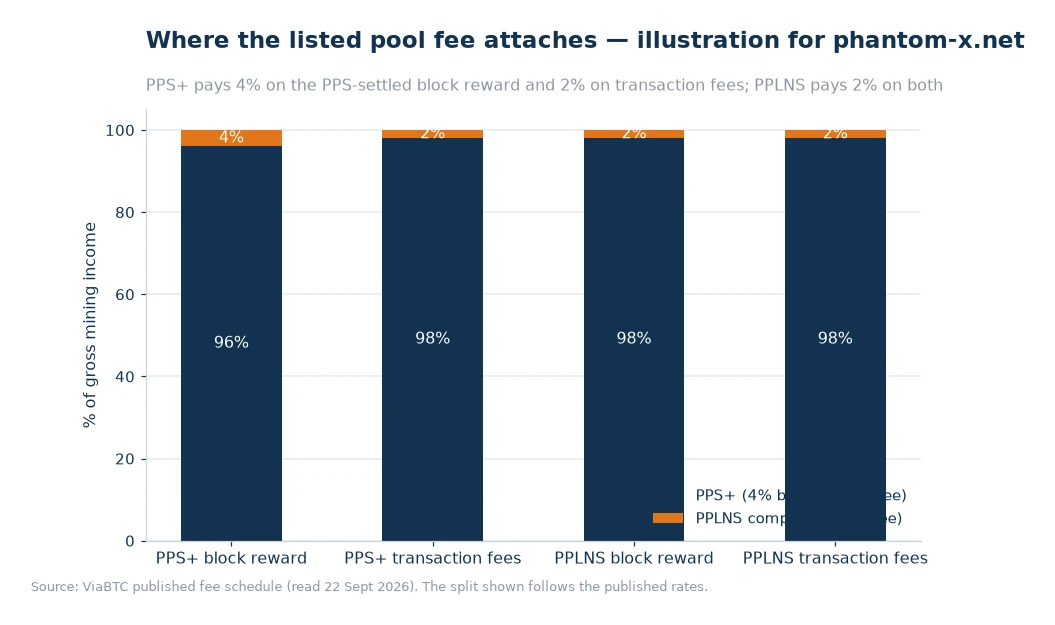
Read the bars as proportions rather than dollars. Ninety-six percent of the PPS-settled block reward reaches the miner, 98% of the transaction-fee component, and 98% of both components together under PPLNS. The two 98% bars are the same size but different products: one charges a single component, the other charges the pair, and the second leaves variance in the miner's account.
Check the rate before you commit hardware
A 10 TH/s operator can test the whole decision in a minute. Enter the hashrate, the price of the coin, the difficulty and the fee rate into a Profit Calculator and the output is the same $0.40 a day of gross income, which is the number the plan hangs on. Compare it with the live figures on pool statistics so the difficulty in your estimate is the difficulty you will actually mine against, and read the component breakdown behind the ViaBTC Pool Fees before choosing a mode — the hourly PPS+ credit and the confirmation-based PPLNS payout suit very different cash-flow needs at this size.
Frequently asked questions
Is 10 TH/s too small to join a mining pool?
No. Pool participation is proportional, so 10 TH/s receives its share of the block reward on the same schedule as a large fleet — hourly under PPS+, or after 6 confirmations across the last 5 difficulty rounds under PPLNS. What changes is the absolute amount: roughly $0.40 a day of gross income at current difficulty.
How long until a small miner receives a payout?
PPS+ credits the account every hour at current difficulty, so the balance grows daily. Whether that balance can be withdrawn depends on the minimum set for the payout method, and at 0.00000474 BTC a day a 0.001 BTC balance takes about 211 days of uninterrupted hashing.
Does a smaller miner pay a different fee rate?
The listed rates do not change with size: 4% on the block reward that PPS+ settles, 2% on the transaction-fee component, or 2% on both under PPLNS. At 10 TH/s those rates are worth about $0.48 and $0.24 a month, so power price and machine efficiency dominate the result.
Keep the sheet small and the record daily
One row per day with hashrate, gross income, the fee, and the kWh drawn will tell a 10 TH/s operator more than any dashboard: it shows the fee as a stable line and the power price as the variable that decides the margin. Re-check the arithmetic after each difficulty adjustment — the current estimate is +1.90%, which trims gross income by a little under a cent a day at this hashrate and costs about $0.22 across a month. A small miner with that record knows precisely when a machine has stopped paying for itself, which is the only decision the numbers have to support.
Data and sources: ViaBTC listed fee schedule[1] and live pool reporting[2]. Network difficulty (132.76 T), implied network hashrate (950.3 EH/s), the 1.90% next-adjustment estimate and the BTC price of $85,294 were read 22 Sept 2026. Power figures are arithmetic on the stated efficiency and price, not a forecast of earnings.