
Where Mining Payouts Land: A Wallet Walkthrough
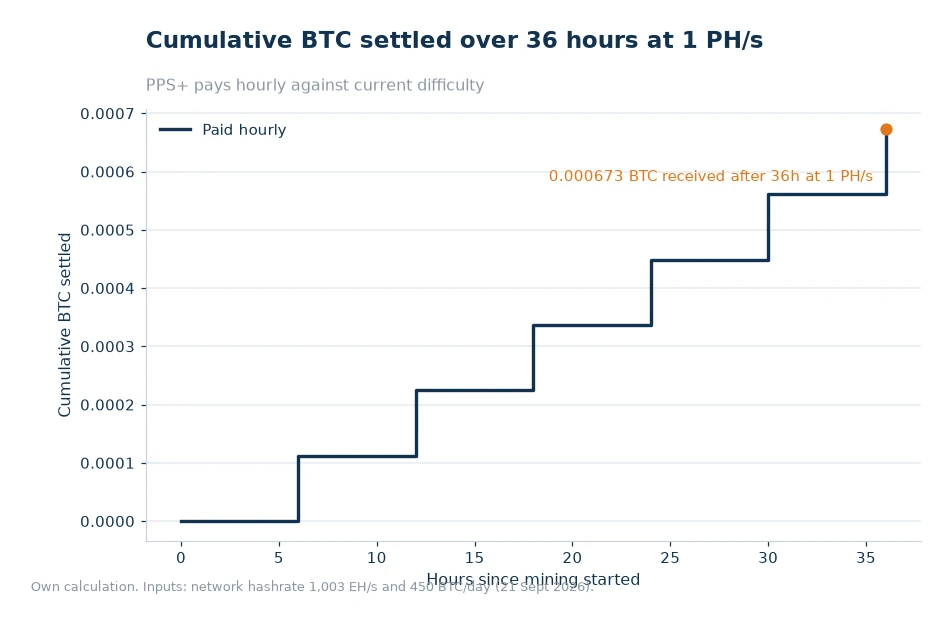
Mining income is only useful once it reaches a balance you can move, convert or withdraw. At 1 PH/s the pool settles about 0.00001869 BTC an hour against current difficulty, which is 0.00044861 BTC a day and 0.00067291 BTC after 36 hours — $56.99 at $84,692 per BTC. This is a walkthrough of the path from share to spendable balance, including the parts that are easy to overlook.
Key takeaways
- 1 PH/s earns 0.00044861 BTC a day, which is 0.00001869 BTC an hour under PPS+ settlement.
- After 36 hours the balance reaches 0.00067291 BTC, worth $56.99 at $84,692 per BTC.
- Mining withdrawals carry no fee, so the balance that arrives is the balance that was credited.
- The multi-currency wallet, Auto Conversion and mining dashboard share one account, which keeps the statement in one place.
From share to credit in four steps
A miner submits shares continuously. The pool validates them, counts them against the current difficulty, and under PPS+ credits the block-reward component hourly. That credit lands in the account balance, which is the same ledger the wallet reads. Withdrawing moves the balance to an external address. Converting changes one listed coin into another. Four steps, and only the first two involve hashing at all.
Most confusion about payouts comes from collapsing those steps into one. A share is not a coin; a credit is not a withdrawal; a conversion is not a sale at a price you chose in advance. Separating them makes it obvious where a delay can occur and where it cannot. Shares are counted continuously, credits arrive hourly, and a withdrawal waits for a network confirmation like any other transfer.
Why hourly settlement changes the balance curve
Under PPS+, income arrives 24 times a day at a rate set by current difficulty. On a chart the balance climbs in small steps, and over 36 hours the shape is close to a straight line with a staircase texture. PPLNS looks different: nothing moves until a block reaches 6 confirmations, then a lump arrives, and the timing of those lumps depends on blocks the pool actually finds.
The consequence for cash flow is larger than the difference in listed rates. An operator paying a daily power bill can meet it from hourly credits. An operator on PPLNS may need to keep a buffer of one or two settlements in the account so that a quiet stretch does not interrupt a payment. Neither arrangement changes the expected total; they change the amount of idle balance required to run smoothly.
There is a second effect that only shows up when difficulty moves. An hourly credit follows the difficulty in force on the day, so a downward adjustment appears in the balance within hours rather than at the end of a round. A PPLNS miner sees the change only after the next block and the next six confirmations. For a small operation, that lag is the difference between noticing a bad week on Tuesday and noticing it on Friday.
Reading the 36-hour curve
The checkpoints below come from a single rate: 0.00001869 BTC an hour at 1 PH/s. Multiply by the number of hours and the cumulative figure follows, which is why the chart is a staircase rather than a curve.
| Hours elapsed | Cumulative BTC | USD at $84,692 | Share of the 36-hour total |
|---|---|---|---|
| 6 | 0.00011215 | $9.50 | 16.7% |
| 12 | 0.00022430 | $19.00 | 33.3% |
| 24 | 0.00044861 | $38.00 | 66.7% |
| 36 | 0.00067291 | $56.99 | 100% |
The share column is the part worth internalising. Every six hours adds one sixth of the 36-hour total, and there is no plateau, no bonus for waiting and no minimum that must accumulate before anything moves. A miner who checks the balance twice a day sees roughly 0.00022430 BTC of movement over each twelve-hour stretch at this hashrate.
Worked example
Follow 1 PH/s from the network formula to the wallet balance, one step at a time.
- Daily BTC per TH/s: 450 ÷ 1,003,000,000 = 0.00000044865.
- 1 PH/s is 1,000 TH/s: 1,000 × 0.00000044865 = 0.00044861 BTC a day.
- Hourly credit: 0.00044861 ÷ 24 = 0.00001869 BTC.
- After 12 hours: 12 × 0.00001869 = 0.00022430 BTC.
- After 24 hours: 24 × 0.00001869 = 0.00044861 BTC, which is the daily figure.
- After 36 hours: 36 × 0.00001869 = 0.00067291 BTC.
- Dollar value at $84,692: 0.00067291 × 84,692 = $56.99.
- Withdrawal: mining payouts are zero-fee, so the amount that leaves the mining balance matches the amount credited, less nothing.
What the wallet adds beyond storage
The ViaBTC Crypto Wallet is a multi-currency wallet inside the same account as the mining dashboard, which means the payout credit, the available balance and the withdrawal history are one statement rather than three. Coins arrive from mining, sit in the wallet, and leave to an external address when you decide. Nothing has to be moved between platforms to become usable.
Auto Conversion is the second piece. It exchanges one listed coin for another without a manual order, which matters when a miner earns one asset and pays costs in another. Because the conversion happens inside the same account, the two legs of the trade appear together, and the effective rate is visible instead of being reconstructed from two exchanges later. That visibility is worth more than a marginally better fill on a small balance. It also removes a withdrawal from the routine: a coin that is already listed can be converted in place rather than sent out and bought back somewhere else.
The parts that go wrong
Three failures account for most missing-payout support tickets. The first is a payout address that belongs to a different network, which sends coins somewhere they cannot be recovered. The second is a withdrawal that is correctly broadcast but sits unconfirmed because the attached fee rate is low for current conditions; the accelerator exists for that case. The third is a miner who expects PPLNS income on a PPS+ schedule and concludes the pool is short-changing them during a quiet stretch.
Each has a cheap defence. Confirm the address format against the coin before saving it. Check the fee rate against current block conditions before a large withdrawal. And read which payment method is active before judging a settlement cadence. None of these is exotic, and all of them cost less to prevent than to unwind. A saved address that has been used successfully once is worth more than any amount of documentation, which is why the first small withdrawal is best treated as a test rather than a transfer.
Frequently asked questions
How often does the balance update?
Under PPS+ the block-reward component is credited hourly against current difficulty, so at 1 PH/s the balance rises by about 0.00001869 BTC each hour, subject to the listed 4% on that component.
Is there a fee to withdraw mining income?
No. Mining payouts are zero-fee, so the credited balance leaves the account at the amount shown, while a network fee still applies to the transfer itself if one is required by current conditions.
Can I convert coins before withdrawing?
Yes. Auto Conversion exchanges one listed coin for another inside the same account, and the converted balance can then be withdrawn or held alongside the mining earnings.
Set the withdrawal rhythm before you need it
Decide the cadence in advance: hourly credits are useful only if the withdrawal schedule matches the bills they pay. A weekly transfer keeps fees and address handling to a minimum, while a monthly one leaves a larger balance exposed to price moves. Run the daily figure through the Profit Calculator to see it in dollars at current difficulty, then choose a rhythm you can keep through a busy month rather than an ideal one you abandon in the first week.
Sources: the ViaBTC wallet and fee pages for settlement cadence, Auto Conversion and zero-fee mining payouts[1]. Chain data read 21 Sept 2026: network hashrate 1,003 EH/s, difficulty 132.76 T, 3.125 BTC per block, 144 blocks a day, BTC $84,692. Published 22 Oct 2026; every balance above is arithmetic on those inputs.